SmartVault: Changing Security as We Know It
SmartVault: Changing Security as We Know It
Project for the 9th Maryland Collegiate STEM Conference
Abstract
Abstract
Click to Expand
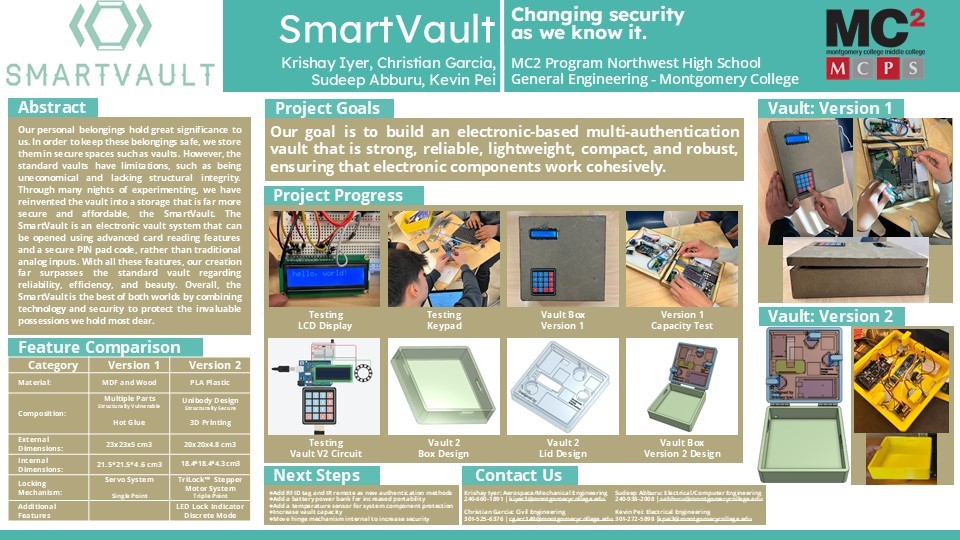
Our personal belongings hold great significance to us. In order to keep these belongings safe, we store them in secure spaces such as vaults. However, the standard vaults have limitations, such as being uneconomical and lacking structural integrity. Through many nights of experimenting, we have reinvented the vault into a storage that is far more secure and affordable, the SmartVault. The SmartVault is an electronic vault system that can be opened using advanced card reading features and a secure PIN pad code, rather than traditional analog inputs. With all these features, our creation far surpasses the standard vault regarding reliability, efficiency, and beauty. Overall, the SmartVault is the best of both worlds by combining technology and security to protect the invaluable possessions we hold most dear.
Our personal belongings hold great significance to us. In order to keep these belongings safe, we store them in secure spaces such as vaults. However, the standard vaults have limitations, such as being uneconomical and lacking structural integrity. Through many nights of experimenting, we have reinvented the vault into a storage that is far more secure and affordable, the SmartVault. The SmartVault is an electronic vault system that can be opened using advanced card reading features and a secure PIN pad code, rather than traditional analog inputs. With all these features, our creation far surpasses the standard vault regarding reliability, efficiency, and beauty. Overall, the SmartVault is the best of both worlds by combining technology and security to protect the invaluable possessions we hold most dear.
Introduction
Introduction
Our goal for this project was to build an electronic-based multi-authentication vault that is strong, reliable, lightweight, compact, and robust. The prototype developed was a custom 3D printed box fitted with curated Arduino electronics to ensure security and elegance. A PIN pad along with an LCD display is used to input and display information respectively. The latest version of SmartVault features a 'TriLock' stepper motor system which uses three stepper motors to keep the box locked and secure.
Our goal for this project was to build an electronic-based multi-authentication vault that is strong, reliable, lightweight, compact, and robust. The prototype developed was a custom 3D printed box fitted with curated Arduino electronics to ensure security and elegance. A PIN pad along with an LCD display is used to input and display information respectively. The latest version of SmartVault features a 'TriLock' stepper motor system which uses three stepper motors to keep the box locked and secure.
Version 1
Version 1
Click to Expand
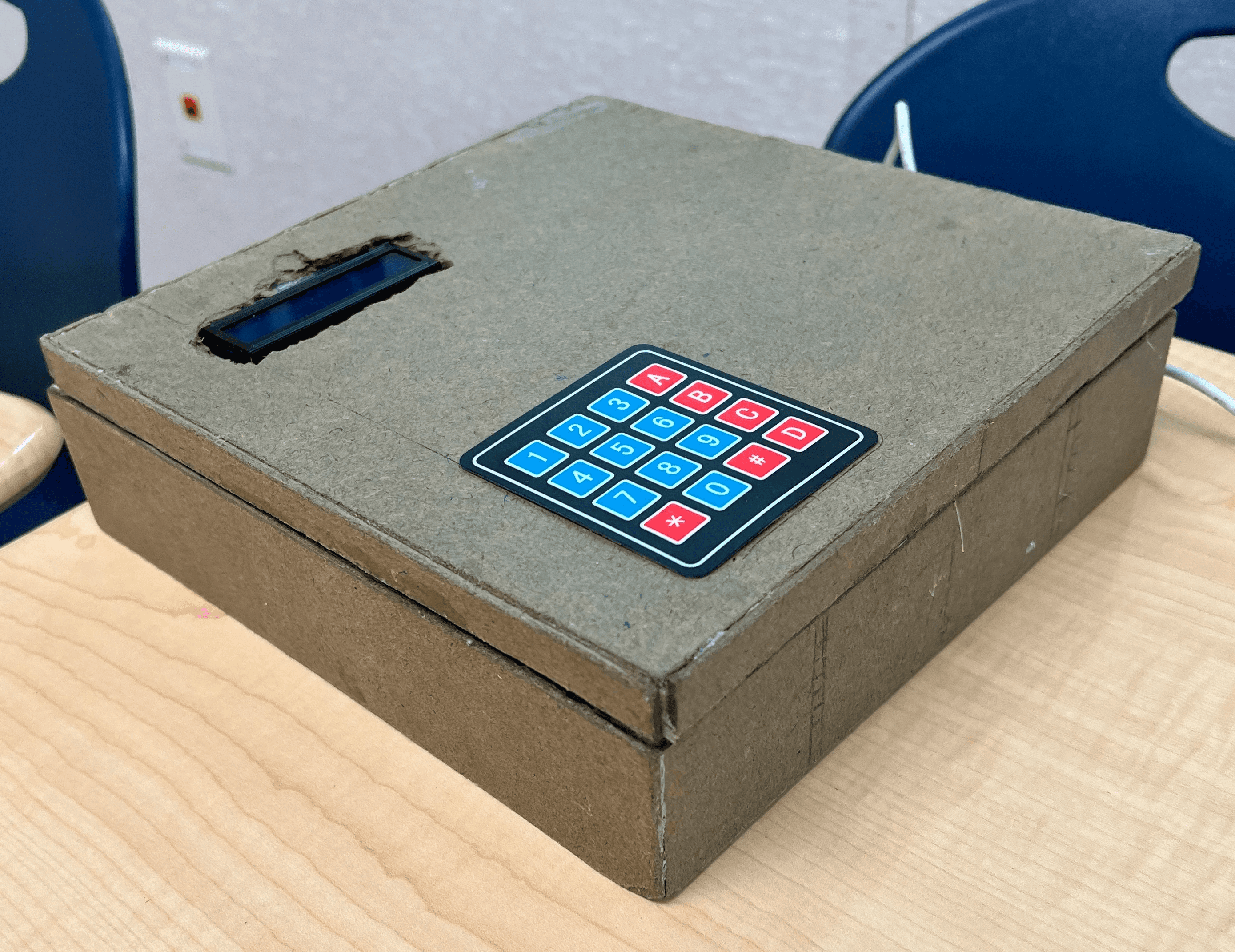
The initial version of the SmartVault was created during our time in the ENES100 - 'Introduction to Engineering Design' class at Montgomery College. For our final project, we were given Elegoo/Arduino kits and instructed to design and build a device. My team gravitated towards the keypad, LCD (Liquid Crystal Display) display, and RFID (Radio Frequency Identification) modules as they seemed the most appealing and complex. After some further discussion with the team, our final idea was to build a multi-authentication vault system to store small valuables. We wanted to try and integrate PIN (Personal Identification Number), RFID (Radio Frequency Identification) tag, and Infrared (IR) remote input, and output our content to an LCD (Liquid Crystal Display) display. Our criteria were to have at least one working user input (PIN, RFID, IR, or others), have compact and organized wiring, and have adequate space to store small valuables or documents.
The initial version of the SmartVault was created during our time in the ENES100 - 'Introduction to Engineering Design' class at Montgomery College. For our final project, we were given Elegoo/Arduino kits and instructed to design and build a device. My team gravitated towards the keypad, LCD (Liquid Crystal Display) display, and RFID (Radio Frequency Identification) modules as they seemed the most appealing and complex. After some further discussion with the team, our final idea was to build a multi-authentication vault system to store small valuables. We wanted to try and integrate PIN (Personal Identification Number), RFID (Radio Frequency Identification) tag, and Infrared (IR) remote input, and output our content to an LCD (Liquid Crystal Display) display. Our criteria were to have at least one working user input (PIN, RFID, IR, or others), have compact and organized wiring, and have adequate space to store small valuables or documents.
Version 2
Version 2
Click to Expand
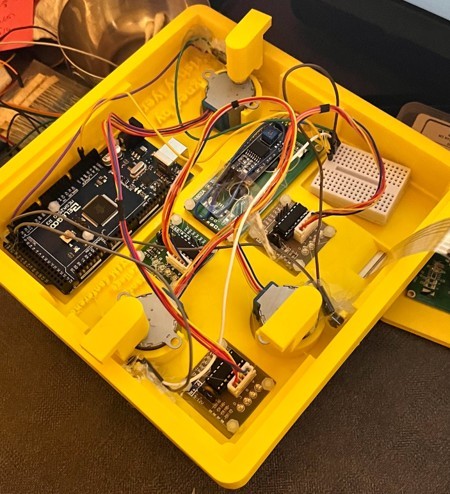
This is the latest version of the SmartVault, and was created for the 9th Maryland Collegiate STEM Conference hosted by Montgomery College. Building off of Version 1, we redesigned the SmartVault to include our enhanced features. In Version 1, the MDF, Wood, and Glue provided a rigid frame, but was also fragile. In addition, the servo used to lock the vault was poorly mounted and allowed the lid to open even when locked, limiting its security. Version 2 solved these issues by using a 3D-printed unibody frame and a three-stepper-motor system (AKA: 'TriLock'). The SmartVault main body included cutouts on the walls to allow the TriLock locks to move into place. We leveraged CAD design to ensure precision, leaving little gap when the SmartVault is locked.
This is the latest version of the SmartVault, and was created for the 9th Maryland Collegiate STEM Conference hosted by Montgomery College. Building off of Version 1, we redesigned the SmartVault to include our enhanced features. In Version 1, the MDF, Wood, and Glue provided a rigid frame, but was also fragile. In addition, the servo used to lock the vault was poorly mounted and allowed the lid to open even when locked, limiting its security. Version 2 solved these issues by using a 3D-printed unibody frame and a three-stepper-motor system (AKA: 'TriLock'). The SmartVault main body included cutouts on the walls to allow the TriLock locks to move into place. We leveraged CAD design to ensure precision, leaving little gap when the SmartVault is locked.
Next Steps
Next Steps
One of the biggest goals for SmartVault is to add RFID tag functionality. We attempted to integrate RFID in both Versions 1 and 2, but to no avail. We also want to integrate a battery for increased portability, a temperature sensor for overheating or freezing protection, and move the hinges internally to increase security. Finally, we are exploring ways to compact our SmartVault circuit and reduce wire clutter, including through custom PCBs. We want to make the SmartVault a secure yet easy-to-use vault for the average consumer, ensuring that your valuables are protected.
One of the biggest goals for SmartVault is to add RFID tag functionality. We attempted to integrate RFID in both Versions 1 and 2, but to no avail. We also want to integrate a battery for increased portability, a temperature sensor for overheating or freezing protection, and move the hinges internally to increase security. Finally, we are exploring ways to compact our SmartVault circuit and reduce wire clutter, including through custom PCBs. We want to make the SmartVault a secure yet easy-to-use vault for the average consumer, ensuring that your valuables are protected.